


The White House recently offered Havana a $100 million “humanitarian aid” package designed to stabilize Cuba’s economy, which has been hit by U.S. sanctions. This is on the condition that Cuba agrees to “meaningful reforms,” opens its economy to foreign investment, and loosens state control, among other things.
Does this strategy sound familiar? Create the crisis, then offer the solution with strings attached. It’s obvious, and it’s right there in our history books.
The U.S. also offered to expand Cuba’s internet access through SpaceX’s Starlink system. This isn’t the generous fix they make it out to be, though. Why? Because the U.S. blocks Cuba from accessing nearby fiber-optic infrastructure. A better solution would be removing the restrictions blocking access in the first place. This is why the Starlink offer is viewed more as an influence, surveillance, and control tactic.
The package is presented as a solution to the country’s growing fuel shortages, blackouts, and humanitarian struggles. Minister of Foreign Affairs for Cuba, Bruno Rodríguez, had a reasonable response to this:
“The best aid that the US government could provide to the noble Cuban people at this or any time is to de-escalate the measures of the energy, economic, commercial, and financial blockade, intensified as never before in recent months.”
He’s referring to recent restrictions, as well as Washington’s January blockade on oil shipments to Cuba, on top of more than 60 years of U.S. strangulation, stemming from the longest-running trade embargo in history.
Even the United Nations condemned the U.S. sanctions, arguing that they are illegal and harm civilians by restricting access to food, electricity, healthcare, and basic development.
What has Washington’s blockade and sanctions left Cuba with?
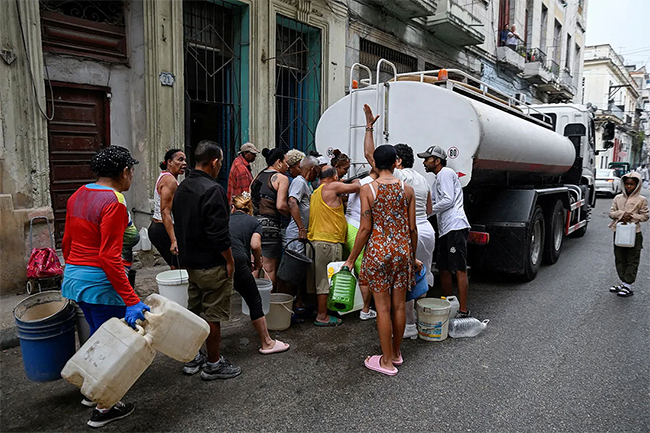
“We have absolutely no fuel oil, absolutely no diesel,” Vicente de la O Levy, Cuba’s minister of energy and mines, said last week. The minister added that the national grid was in a “critical” state and the government has “no reserves.” Others report that water is available for only one hour a day, sometimes even less.
And this is when the United States swooped in with its rescue plan.
Why is the U.S. aggressively forcing Cuba’s hand by harming its citizens? Could it be that Trump needs a win to compensate for the Iran war? After all, he publicly declared: “I do believe I’ll [have] the honor of taking Cuba. That’d be good. That’s a big honor.” He went on to say, “Whether I free it, take it, think I can do anything I want with it.”
Maybe it’s about countering China, since Cuba and Beijing are close trade partners, and China has spoken out in Cuba’s defense. Or perhaps this is part of the regime change effort that Secretary of State Marco Rubio has pushed for, starting with making sure ex-Cuban leader Raúl Castro is out of the way.
No matter what the motive may be, the people suffering most from this are everyday Cuban citizens trapped in the middle of a geopolitical power play.
The post U.S. Cripples Cuba, Then Offers Help appeared first on Redacted.
Continue reading...