


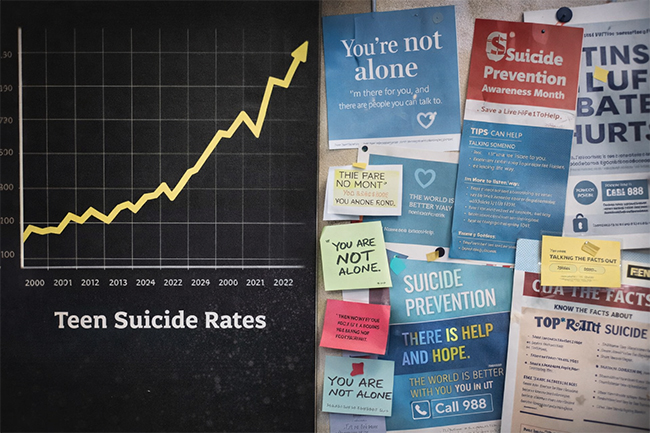
Researchers admit that youth suicide prevention isn’t working and…they don’t really know what they’re doing. Translation: this is experimentations on our kids.
In a new JAMA Pediatrics piece, researchers acknowledge that suicide rates are rising, especially among younger kids, and that they don’t have strong proof most interventions are actually effective.
They call it an “evidence paradox.” That means that the highest-risk kids are the hardest to study, so the kind of proof the system demands will never exist.
So why do experts continue to push programs without clear evidence they’re changing outcomes?
And here’s the part people notice but don’t say out loud: as awareness campaigns and interventions have expanded, suicide rates have also climbed. That doesn’t prove causation, but it does at least raise the question!
JAMA doesn’t take on that question, but they do make one thing clear: we’re doing more than ever, with less certainty than you’d expect and the numbers are still moving in the wrong direction.
You do what you want in your family, but in ours, we opt our children out of suicide discussions at schools, doctors offices, and other places for this very reason.
The post The Teen Suicide Paradox appeared first on Redacted.
Continue reading...