


Large institutional investors have been pulling back from the for-sale housing market for years, and their retreat appears to be accelerating.
While lawmakers in Washington debated restrictions on corporate ownership of single-family homes, major investors were already selling off properties well before President Donald Trump pushed for limits on future purchases.
New data suggests that many of these firms are now net sellers, particularly in major metropolitan housing markets where they once expanded aggressively.
The shift is changing the structure of the housing market and signaling a broader change in how large investors want to deploy capital in residential real estate.
Big Investors Are Listing More Homes Than They Own
According to research from Parcl Labs, institutional investors are making up a much larger share of homes for sale than their share of the overall housing stock.
That imbalance is visible across major cities, but it is especially striking in some Sun Belt markets.
In Dallas, for example, investors own 9.2% of the housing stock but account for 22.8% of new for-sale listings. Similar patterns have emerged in cities such as Philadelphia and Houston, where investor selling has become increasingly noticeable.
Parcl Labs found that some firms are moving more aggressively than others. FirstKey Homes appears to be among the most active sellers, with far more listings than peers and deeper price reductions.
The company has reportedly been cutting prices by an average of about 10% from original list prices and adjusting those prices frequently.
Analysts say the motivation is straightforward. Rental income has become less attractive relative to the gains investors can lock in by selling homes and holding cash.
Why Investors Are Pulling Back
Jason Lewris, co-founder of Parcl Labs, said some investors are simply trying to reduce risk in an unstable housing market.
Rents are no longer holding up as well relative to sales values, and borrowing costs remain elevated. That changes the return profile for investors that acquired homes for rental income.
Rather than continue to hold properties under less favorable conditions, many are deciding that selling now offers better risk-adjusted returns.
This does not mean institutional investors are abandoning residential real estate altogether. Instead, many appear to be shifting into a different strategy.
The Political Push Came After the Trend Began
Trump signed an executive order in late January aimed at curbing purchases of single-family homes by large institutional investors.
The proposal seeks to limit future acquisitions by companies that own large portfolios of rental homes, although it does not require them to sell the properties they already own.
Congress has since taken up related legislation, with House and Senate bills proposing different thresholds for what qualifies as a large investor.
But the data suggests the policy push followed a trend already underway.
Parcl Labs reports that institutional investors had started buying fewer homes as early as 2022. Selling intensified in late 2024. In Atlanta, for instance, investors are now reportedly selling nearly two homes for every one they buy.
That means the policy debate is arriving at a moment when many major investors are already rethinking the economics of the resale housing market.
Institutional Investors Are Smaller Than Many Assume
The role of big investors in housing often draws intense attention, but they still represent a relatively small slice of the broader market.
According to analysis from Bank of America, single-family rentals make up about 10% of the total U.S. housing stock.
Most of those rentals are not owned by giant Wall Street firms. Roughly 80% are held by small landlords with fewer than 10 homes. Investors who own between 10 and 1,000 homes account for another 17%.
Large institutional investors, defined as owners of more than 1,000 homes, make up only about 3% of the single-family rental market.
Even so, their influence can be significant in specific neighborhoods and metro areas where they concentrated purchases during the years following the subprime mortgage crisis.
Build-to-Rent Is Becoming the New Focus
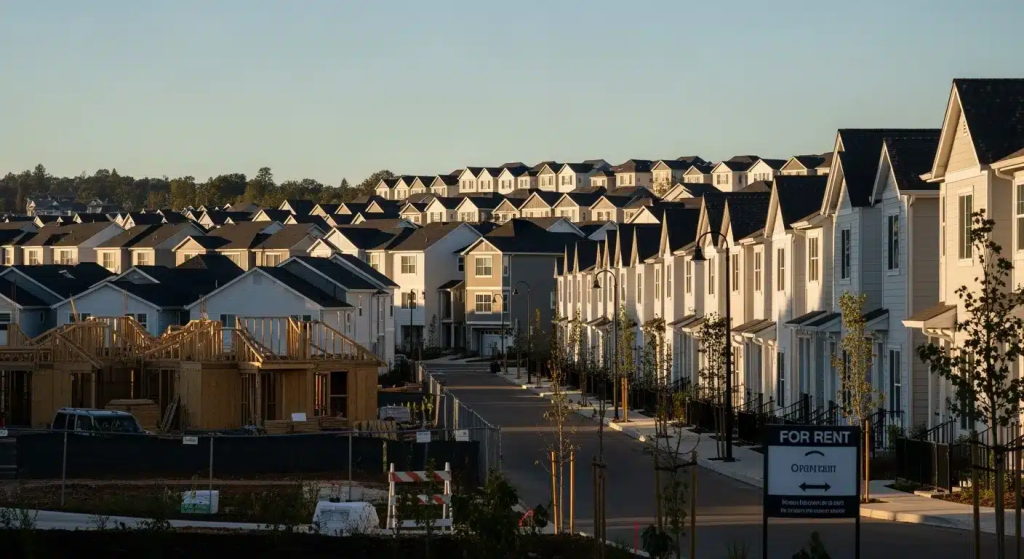
Rather than buying existing homes on the resale market, institutional investors are increasingly shifting toward build-to-rent communities.
This strategy involves either buying newly built homes directly from builders or developing entire neighborhoods designed from the start as rental communities.
Rick Palacios of John Burns Research and Consulting said this reflects a natural recycling of capital. Home prices rose sharply after 2020, giving investors an opportunity to sell appreciated properties and redeploy funds into newly built rental housing that may generate better yields.
Builders can also adjust pricing more quickly than resale sellers, which gives investors more flexibility when negotiating purchases.
One of the clearest examples comes from Invitation Homes. In its latest earnings report, the company said nearly all of its acquisitions in 2025 were newly constructed homes bought through homebuilder relationships.
At the same time, it sold more than 1,300 homes during the year, often to families buying for their own use.
Invitation Homes has also expanded deeper into the build-to-rent model by acquiring ResiBuilt Homes, a company focused on delivering rental homes in high-growth Southeastern markets.
Another large player, AMH, has been developing entire rental communities for years. The firm says it has already added more than 14,000 newly built homes to U.S. housing supply through its ground-up development program.
What the Shift Means for Housing
The institutional investors selling homes trend could offer some relief in markets where families have struggled to compete with large cash buyers.
However, the broader impact may be more nuanced.
If big investors keep selling resale homes while increasing build-to-rent development, they may reduce pressure in one part of the housing market while continuing to expand their role in another.
For homebuyers, the shift could mean more existing homes become available for owner-occupants. For renters, it could mean a growing supply of professionally managed single-family rentals.
Either way, the behavior of large investors is evolving. The strategy that once centered on snapping up existing homes after the housing crash is increasingly being replaced by a longer-term push into purpose-built rental communities.
The post Institutional Investors Are Selling More Homes as Rental Strategy Changes appeared first on .
Continue reading...