


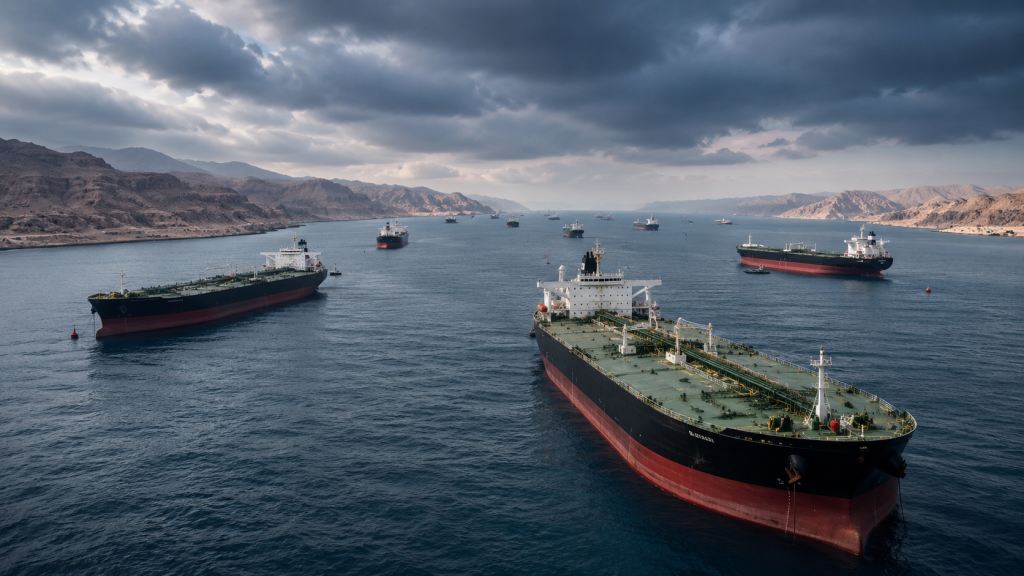
President Donald Trump’s order to blockade the Strait of Hormuz has dimmed hopes for a rapid end to the Iran conflict and threatens to push the world’s most severe energy shock in recorded history into even more dangerous territory.
The blockade took effect Monday morning, targeting vessels of all nations entering or leaving Iranian ports and coastal areas along the Arabian Gulf and Gulf of Oman.
Within hours of Trump’s announcement, tanker traffic through the strait, which had barely begun to recover during a two-week ceasefire, ground to a halt again. At least two vessels that appeared to be heading for open water turned back, according to Lloyd’s List Intelligence.
Oil Markets React Sharply
Crude prices surged immediately after the announcement as investors scrambled to price in a further tightening of Persian Gulf supply.
U.S. West Texas Intermediate futures jumped more than 8% to around $104 per barrel, while international benchmark Brent crude rose more than 7% to nearly $102.
The spike underscores how sensitive global energy markets remain to any development involving the strait, which carried roughly one fifth of the world’s oil before the war began on February 28.
Analysts Warn Prices Could Reach $150
Energy analysts are warning that a full blockade could drive crude prices to levels that would inflict severe damage on the global economy.
Trita Parsi of the Quincy Institute for Responsible Statecraft said that taking more oil off the market, particularly the limited supply still exiting the Persian Gulf, would push prices toward approximately $150 per barrel. That threshold is widely considered recession territory for many major economies.
Beyond crude, prices for fertilizer and helium, critical inputs for food production and semiconductor manufacturing respectively, are also expected to keep climbing. The IMF and World Bank signaled last week that they would downgrade global growth forecasts and raise inflation projections, with emerging markets expected to be hit hardest.
The Worst Energy Shock in History
Energy experts are drawing comparisons to the 1970s oil embargo, and in some cases saying the current disruption is worse.
Fatih Birol, head of the International Energy Agency, described the current situation as the most severe energy shock the world has ever witnessed, more damaging than the oil crises of the 1970s and the Ukraine war combined.
Daniel Yergin, vice chairman of S&P Global, said there has never been anything of this scale in modern history, noting that not even the Iran-Iraq war of the 1980s or Iraq’s invasion of Kuwait in 1990 came close to matching the current disruption in magnitude.
Some analysts caution that the price response has so far been more contained than feared, partly because the global economy is significantly less oil-intensive than it was in the 1970s.
Advances in wind, solar, and nuclear energy have also diversified the energy mix in ways that provide partial insulation against oil shocks. However, experts warn that a further escalation could close that gap quickly.
China Caught in the Crosshairs
The blockade also introduces significant risks in U.S.-China relations. China remains Iran’s largest oil buyer and has continued receiving shipments through the strait since the conflict began.
A blanket enforcement action against tankers carrying Iranian crude could directly threaten that supply, adding friction ahead of Trump’s planned trip to China. The Trump administration further raised the stakes by threatening an additional 50% tariff on China if Beijing supplies advanced defense equipment to Tehran.
India and Pakistan, both of which have negotiated safe passage arrangements with Iran, could also find themselves caught between competing pressures.
Negotiating Tactic or Dangerous Miscalculation?
Analysts are divided on whether the blockade represents genuine escalation or a pressure tactic designed to force Iran back to the negotiating table.
Parsi noted that neither side has explicitly stated that talks will not resume, suggesting the moves should be interpreted within the context of ongoing negotiations rather than as a definitive end to diplomacy.
However, other analysts warn the strategy carries serious downside risk. A miscalculation could trigger Iranian counterstrikes and restart a cycle of military escalation that the ceasefire had temporarily interrupted.
Iran’s Revolutionary Guard Corps warned that military vessels approaching the strait under any pretext would be treated as a ceasefire violation.
Legal challenges also loom. Several experts noted that under international maritime law, the United States has no authority to close or impede transit passage through the Strait of Hormuz, adding another layer of complexity to an already volatile situation.
The post Hormuz Blockade Could Deepen World’s Worst Energy Crisis and Risk a Dangerous Misstep appeared first on .
Continue reading...