



Executive summary
For the average American, hantavirus infection remains extremely rare.
Hantavirus spreads primarily from infected rodents to humans, especially through exposure to aerosolized rodent urine, droppings, or saliva in enclosed spaces.
Human-to-human transmission is very uncommon and has mainly been documented with the Andes strain in South America, not with the main US strain (Sin Nombre virus).
Reported hantavirus cases are relatively rare in the US.
Hantavirus pulmonary syndrome (HPS) can be severe and has historically had a case fatality rate of roughly 30–40% in reported US cases, although outcomes improve with early recognition and intensive supportive care.
The incubation period is typically about 1–8 weeks, commonly around 2–4 weeks.
Diagnosis is usually made with PCR and antibody testing after symptoms begin. PCR tends to be more useful early in illness, while antibody tests become more reliable after antibodies develop.
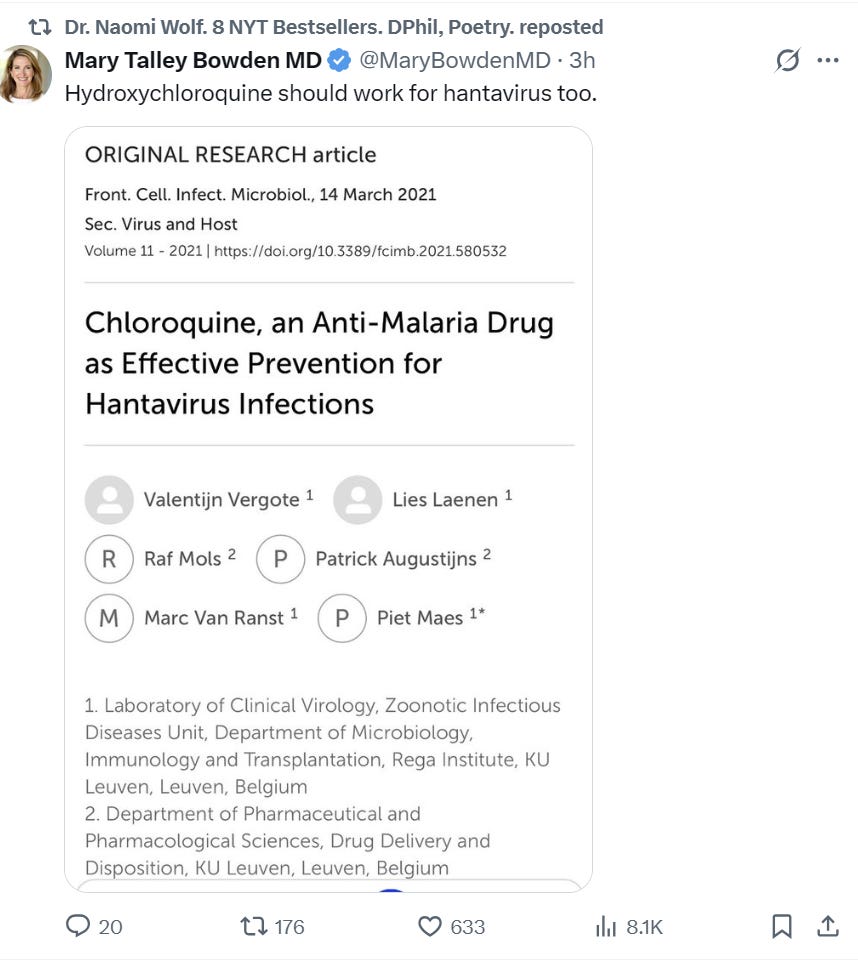
Some antiviral or repurposed therapies such as ribavirin, hydroxychloroquine, and ivermectin have been discussed in portions of the medical literature, but supportive care remains the standard accepted treatment for HPS and evidence for these therapies is limited or mixed.
Best X post to read for more info: By Martin Zizi who wrote, “In Belgium - for example - we have each year between 150 and 350 cases of Hantavirus patients. We do not lose them.” He notes that HCQ can be used for prevention and treatment (see this peer-reviewed literature article).
Share
Continue reading...