


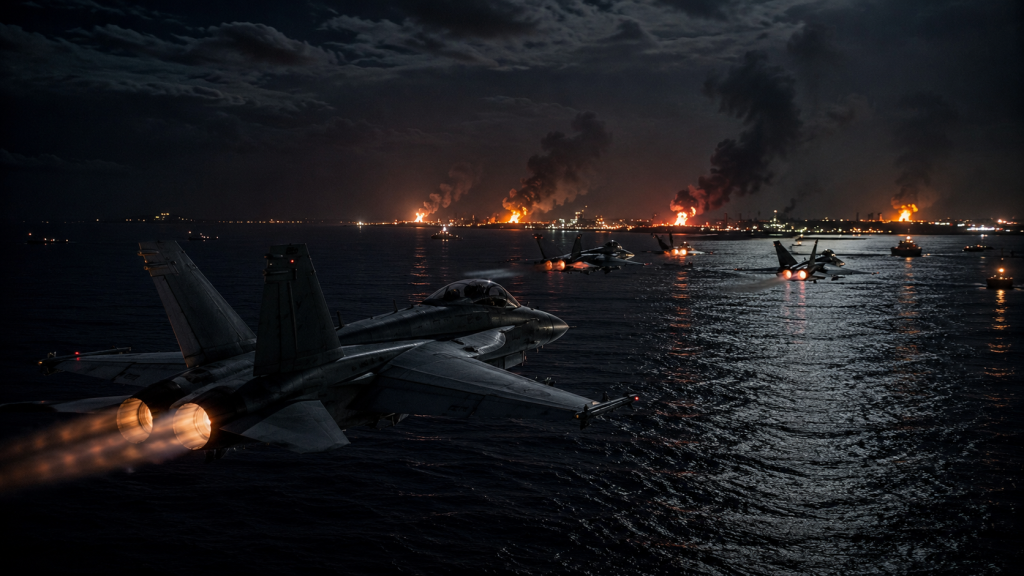
The United States and Iran clashed overnight in the most significant escalation since their ceasefire took effect in early April, with Kuwait and Bahrain caught in the crossfire and diplomatic efforts to reach an interim peace deal facing fresh and serious strain.
The strikes come as negotiators from both sides have been working toward a rough framework to extend the truce by two months and reopen the Strait of Hormuz.
The final details of that memorandum of understanding are still being negotiated, and the overnight violence has cast new doubt on whether an agreement can hold together.
How the Overnight Clashes Unfolded
The exchange of fire began after the U.S. military struck an empty oil tanker heading to Iran on Tuesday. Shortly after, American forces came under missile and drone attack.
Iran targeted the U.S. Navy’s main regional base in Bahrain and the Ali Al-Salem airbase in Kuwait. At least one person was killed in a separate Iranian strike on Kuwait’s civilian airport, which caused significant damage and forced a temporary suspension of flights for several hours.
The U.S. military also struck a communications tower on the Iranian island of Qeshm, located near the strait, during the skirmishes.
Secretary of State Marco Rubio told the House Foreign Affairs Committee that U.S. forces were actively shooting down Iranian drones aimed at commercial vessels, and acknowledged the cycle of retaliation the situation creates.
“At that point, the Iranians will respond to that by targeting some facility in the region in retribution,” Rubio said. “On occasion, in order to protect our own forces, we don’t just strike the drones, we strike the people who launch those drones.”
Iran’s foreign ministry said the U.S. attacks on the Iranian tanker and Qeshm were launched from Kuwaiti and Bahraini territory, holding both governments directly responsible.
Kuwait rejected the accusation and expelled two Iranian diplomats in protest over the airport strike, further straining Gulf diplomatic ties.
Markets React to the Escalation
Oil prices surged on the renewed violence, sending stocks lower and pushing bond yields higher as traders priced in both tighter energy supply and increased inflation risk.
The flare-up interrupted a period during which oil prices had been declining on hopes that a peace framework was close, and the reversal underscored just how fragile that optimism had been.
Lebanon Remains a Central Point of Contention
Beyond the direct military exchange, the situation in Lebanon continues to complicate any path to a comprehensive interim agreement.
Israel has maintained its campaign against Hezbollah in Lebanon and is pushing to continue those operations even within any ceasefire framework. Iran has insisted that a halt to Israeli operations in Lebanon must be part of any deal with the United States.
Trump urged Israeli Prime Minister Benjamin Netanyahu in a call on Monday to abandon plans to bomb Beirut. Trump confirmed Wednesday that the call was tense and that he used profanity during the exchange.
“I was a little bit perturbed at him constantly fighting with Lebanon,” Trump said in an interview that aired Wednesday.
Netanyahu said publicly that his relationship with Trump had not changed and described the U.S. president as “the greatest friend that Israel has ever had in the White House.”
Peace Talks Continue Despite the Violence
Despite the overnight clashes, both sides have indicated that diplomatic channels remain open.
Iranian Foreign Minister Abbas Araghchi said through the semi-official Tasnim news agency that communication between Iran and the U.S. has not been severed, though he acknowledged that no tangible progress has been achieved in the negotiation process.
Negotiators are still grappling with several unresolved questions beyond Lebanon.
These include whether Iran will agree to allow free passage for ships under an interim accord, how billions of dollars in Iranian funds frozen in countries like Qatar would be handled, and whether Tehran will agree to destroy or surrender its stockpile of highly enriched uranium.
Nuclear Risk Assessment Has Worsened
In a significant development buried beneath the daily headlines of military exchanges, Western officials have told Bloomberg that the risk Iran is covertly pursuing nuclear weapons is actually higher today than it was before the U.S. and Israeli strikes began, according to data circulated by the United Nations’ atomic watchdog.
That assessment, if accurate, represents a troubling conclusion for a conflict whose stated primary objective was to prevent Iran from obtaining a nuclear weapon.
Separately, the Trump administration sanctioned Iran’s largest cryptocurrency exchange and three other entities as part of its ongoing economic pressure campaign designed to push Tehran toward a deal.
A Framework Exists but the Path Remains Uncertain
The existence of a rough memorandum of understanding framework is the most concrete diplomatic progress since the war began, but the overnight strikes illustrate the difficulty of translating that framework into a signed and durable agreement while military operations on multiple fronts continue.
Trump has projected confidence throughout the conflict that a deal is within reach, but Iran has consistently pushed back against American demands and has reiterated publicly that it is prepared for a resumption of all-out war if negotiations fail.
The post US and Iran Exchange Military Strikes in Most Serious Flare-Up Since April Ceasefire appeared first on .
Continue reading...